Long Range Private Jets: So Far Away
/While the Olympics certainly draw attention, the FIFA World Cup is inarguably the biggest single-sport athletic competition in the world. In 2022, about 5 billion – yes, billion – people engaged across media about the tournament and approximately 1.5 billion watched Argentina beat France in the final match.
In the summer of 2026, the (men’s) World Cup will go even grander than usual. Thanks to a joint bid by Canada, Mexico and the U.S., matches will take place across three countries. While the U.S. previously hosted the men’s Cup in 1994, this tournament will literally be twice as large, with 48 teams competing in 104 matches vs. 24 teams in 52 matches.

Photo Credit: Anton Vierietin, iStock / Getty Images Plus
The event will draw fans from all over the world. Many of those attending – especially those in Europe and Asia – will need to travel by air to North America. Certainly, some will squeeze themselves into economy airline seats, or sojourn via group charter. Others will spring for a first-class ticket.
However, there exists another alternative – private jet travel. Which brings up another change from 1994 – vastly more options for flying internationally on business jets. The growth in the long-range private jet market has provided countless new choices for flyers seeking the convenience of charter over a greater distance. If you’d like to know more about long-range jet options – for the World Cup or otherwise – read on.
Long Ago, Far Away
Initially, private jets were primarily used for short trips. Commercial airlines started offering transatlantic trips in 1939, but the private jet market itself didn’t really take off until some time after World War II supercharged jet engine evolution. It wasn’t until the introduction of the Gulfstream II in 1967, with its range of 3,550 nautical miles, that business jets could safely fly across the Atlantic.

Gulfstream G650ER LX-ICE Engine. Photo Credit: SCM Jeans, iStock / Getty Images Plus.
For the next couple of decades, that was close to the maximum range that private jet travelers could expect…but change was coming. Bombardier Aviation had been looking into developing a longer-range business jet after it bought Canadair in the mid-1980s. By the time of the first World Cup in the U.S. in 1994, a team of about 200 engineers was working on what would become the Global Express, which entered service in mid-1999 offering a range of 6,500 nautical miles.
However, Gulfstream hadn’t stood still. Pushed by Bombardier’s work on the Global Express, the Gulfstream V was certified in 1997, also offering a range of 6,500 nautical miles. Now, Bombardier, Gulfstream and Dassault’s Falcon models dominate the long-range market for private jets.
Room to Move
Today, long-range private jets with all seats full top out around 7,500 nautical miles of nonstop range. But it’s not just the distance they can fly that sets them apart. In order to hold enough fuel to travel that far, long-range private jets have to be larger than their shorter-range alternatives. The humans who fly on those jets also aren’t willing to endure cramped cabins for longer flights.
Long-range business jets can provide more space for everything from kitchens to fully flat beds to lounge zones. Areas can be allotted for private discussions and other meetings. Some models feature showers with larger lavatories. Wi-Fi and cabin systems tend to be more advanced and robust in order to allow for long work hours in the air. As per jet card company BlackJet, long-range private jets “fundamentally transform global travel from a logistical endurance test into a strategic advantage.”
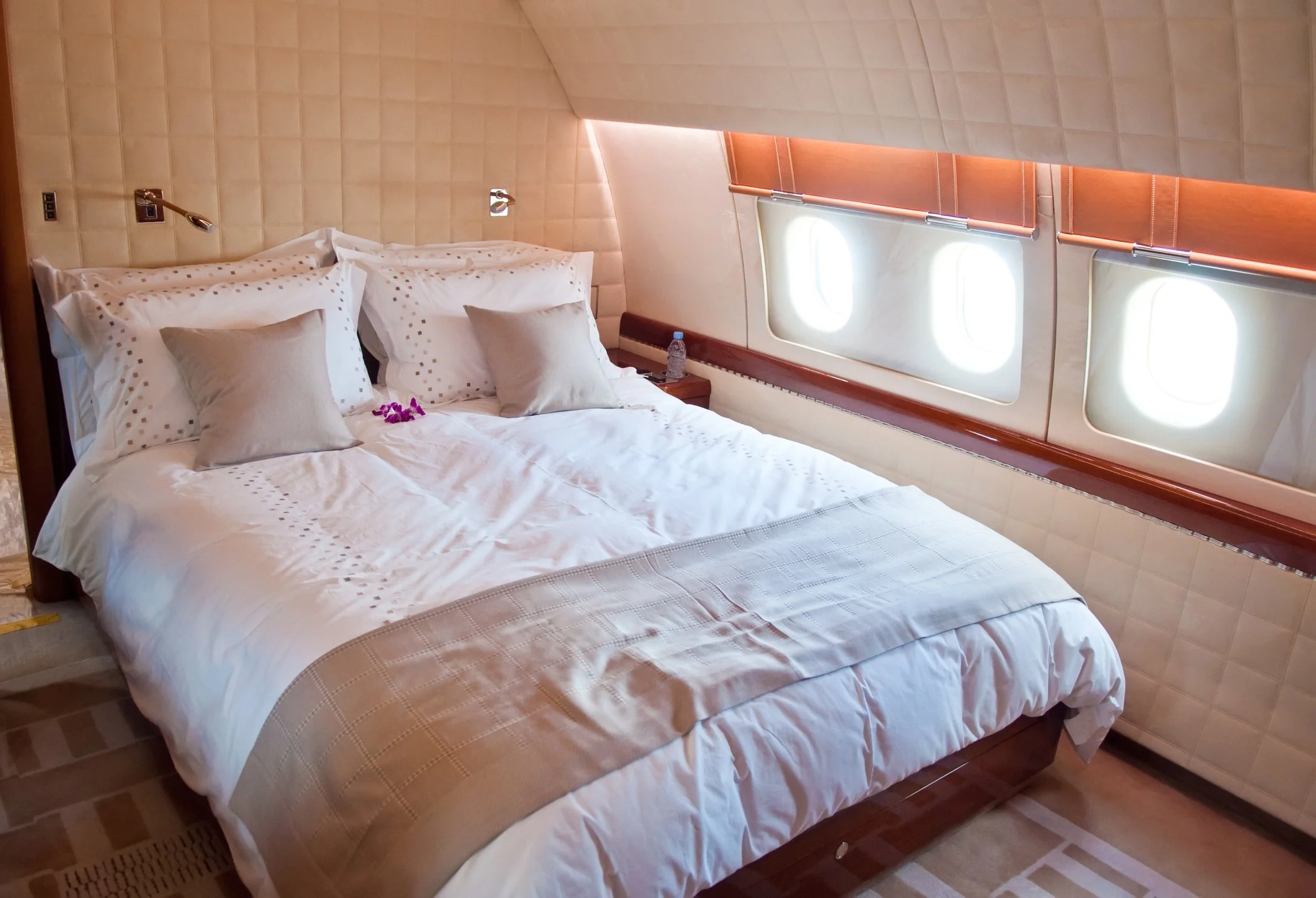
The incorporation of these options does come with tradeoffs. While hypothetically a long-range private jet can hold more travelers than smaller options – say, 12 to 19 passengers as opposed to the eight to 10 passengers a super-midsize jet can accommodate – making sure those passengers have enough room to do more than just sit upright comes with a price.
“A Gulfstream G650 can officially seat up to 19 people and sleep 10, but that’s not the reality,” says Wendi Matthews-Ortiz, VP of executive aviation for Hunt & Palmer USA. “The reality is that it can sleep five to seven people with a typical layout. A custom layout may fit 10 passengers sleeping, but there’s nowhere for anyone else to sit.”
Time on My Hands
Another common demand on space in long-range private jets is the crew rest area. Whatever the mechanical capabilities of an aircraft in terms of flight range, human beings still need to serve as pilots (autopilots notwithstanding), and those human beings have limitations that influence aviation regulations.
The U.S. represents the single largest market for private jet flights in the world, with more than two-thirds traveling at least part of their way through its skies. As a result, we’ll start with its policies – specifically, Part 135 of the U.S. Code of Federal Regulations, which applies to unscheduled flight operations for aircraft with a maximum of 30 seats with paying passengers.
For Part 135 flights with a single pilot, the maximum duty period is around eight hours. Adding a second pilot stretches that time to 14 hours, assuming the start isn’t between midnight and 6 am local time. After this duty period, the pilot must have at least 10 consecutive hours of rest time, in “appropriate accommodation.”

Pilot drained from long flying hours. Photo Credit: Globalmoments, iStock / Getty Images Plus
Adding a third pilot gives a bit more leeway, but only so much – the crew can’t be assigned more than 18 duty hours in 24 consecutive hours, and the flight can’t stay aloft for more than 12 hours. Turning the pilot trio into a quartet can stretch things into 20 duty hours with a maximum of 16 hours aloft. However, with these relief pilots comes another requirement – sleeping facilities.
“Usually, there’s a built-in area for crew rest. It has to be closed off from the passengers and it must be approved by the FAA,” says Matthews-Ortiz. “Typically, it’s for one pilot, not two, so having four pilots on one flight is very unlikely.”
Europe, the next largest business aviation market, has its own approach to regulating crew duty time for charter jets. Those in the industry say the European approach as directed by the European Union Aviation Safety Agency (EASA) is actually more nuanced and flexible than the mandates enforced by the U.S. Federal Aviation Administration (FAA).
“The American rules particularly haven’t changed in a long time. They don’t take into account a lot of things,” says charter aviation consultant Paul Travis. “The regulations haven’t evolved and really aren’t fit for purpose in the type of operations the public are looking for.”
EASA’s rules on flight time limitations are less easy to sum up briefly than the FAA’s. They take circadian rhythm more into account and call for formal fatigue-management systems. Flights that cross time zones face more scrutiny in terms of crew duty time than those that don’t. Timing is emphasized more than rigid hour limitations.
In 2018, the U.S. Congress directed the FAA to establish a group that would analyze Part 135 rest and duty rules to see which changes might be warranted. The 20-person entity with representatives from the aviation industry and aviation safety, dubbed the Part 135 Pilot Rest and Duty Rules Aviation Rulemaking Committee (ARC), started work in 2019, considering how best to incorporate the latest science on fatigue into calculations of duty time for charter flight crews.
Under the ARC’s framework, released in 2022, regulations for charter flights would consider the number of legs flown, time zones crossed, circadian rhythm – all familiar to those knowledgeable of Europe’s approach to business aviation.
Sticking With the Status Quo
Unfortunately, from the perspective of many in the industry, the FAA has not rushed to incorporate the ARC’s suggestions. One likely factor is the sheer growth in Part 135 flights following a period of low activity at the beginning of the COVID-19 pandemic. Globally, departures of private jets operated as charter or fractional ownership charter flights have increased by more than 30% from 2019 (the last full year before the pandemic) to 2025. The U.S. is the largest market for these operations by far, accounting for almost three-quarters of all flights in 2025 after a 6% increase year-over-year.
This growth has been most pronounced in super midsize jets, which hold about eight to 10 passengers comfortably and can fly about 3,500 to 4,500 nautical miles. However, the next most significant subset in terms of growth in flight activity is the ultra long-range jet, with departures increasing by 56% in 2025 over 2019.
This increase has come despite the fact that ultra long-range business jets are the most expensive category to charter, by far. While fees will depend heavily on time flown, departure and arrival locations, amenities, taxes and other factors, the cost to charter a super-midsize jet will likely top out around $8,000 per hour, while an ultra long-range jet would max out at more like $18,000 per hour.
“We certainly get requests for quotes for longer-range flights, but even people who charter may find that traveling first class makes more sense when they look at the price tag,” Matthews-Ortiz recounts. Clients looking to travel, say, from Tokyo to Dallas for the World Cup would likely face a price tag starting at $200,000 for a one-way trip and $350,000 for a round trip, very roughly.
Flying internationally into a country on a commercial airline and then booking a domestic charter to go from city to city also helps customers avoid violating laws against cabotage. Basically, most nations want to prohibit aircraft registered in another country from taking paying passengers from point to point once they arrive. Foreign-origin trips that start and end with the exact same passengers can be allowed, but if you think you might want to drop off one of your traveling companions and add others while flying city to city for (say) the World Cup, you’re best off chartering a domestic airplane.
GOAL!
Given all of the global uncertainties currently at play, who, exactly, will be coming to the World Cup is still somewhat up in the air. Flights from many countries, especially those in the EU, will need to avoid Russian airspace. Relations between the U.S. and other nations are somewhat unpredictable. The war in the Middle East may be over or may be active.
That having been said, those in the aviation industry still expect that soccer fans won’t want to miss the chance to see their national teams battle it out in person. While many will fly commercial at least for their international travel, expect to see some long-range private jets as well.
“There will be some people who will be liquid enough to think, let’s get an ultra long-range large cabin jet that will fly the group from Europe or Asia and stay with them for the duration of the tournament,” Travis predicts. “Overall, the trend is that use of ultra long-range jets has increased and is increasing. The demand is definitely there.”