Per Seat Charter: Flying Private 1-by-1
/When it comes to overall comfort in travel, charter aviation offers one of the best options around. While airline journeys are certainly faster than what cars or even most trains can provide, it also involves early airport arrivals, long lines, complicated security processes, crowded terminals, unexpected delays, narrow seats and all sorts of other inconveniences and frustrations that make flying something to be tolerated rather than enjoyed.

Check-in Queue at the airport. Photo Credit: Ilona Titova, Istock / Getty Images Plus
Private jet service, on the other hand, lets passengers journey in a more humane manner, from easier security checks to lower people density at much smaller terminals to clearer communication to roomier seating options. While business jets may or may not offer true luxury in the air, they do represent a clear advantage in terms of ease and convenience.
However, airlines do offer a few notable advantages over charter – essentially, simplicity and specificity. Charter travel historically has involved purchasing the right to fly an entire aircraft to a destination at your preferred time, which means that you pay the full cost for pilots, any flight attendants, fuel and other necessities. Scheduled service airlines, on the other hand, sell individual seats intended to cover only a fraction of operational costs – basically, selling the ability to travel rather than the flight itself.
Scheduled service air travel and charter aviation have traditionally been viewed as separate categories, with the implicit assumption that airline journeys were sold per seat while charter flights were sold per flight. Now, though, new technologies and trends are causing the lines to be more blurred, with something like per-seat charter emerging. If you’d like to know how this works – and how you might be able to benefit – read on.
Many Parts of the Whole
While the U.S. certainly does not represent the entirety of the global air travel market, it does play an outsize role in charter aviation. More than two-thirds of all business flight departures occur in North America, and while Canada and Mexico play their roles in that total, the U.S. is the big driver. Europe may have the larger population – more than 700 million residents vs over 600 million in North America – but it only accounts for about 15 percent of business jet departures.
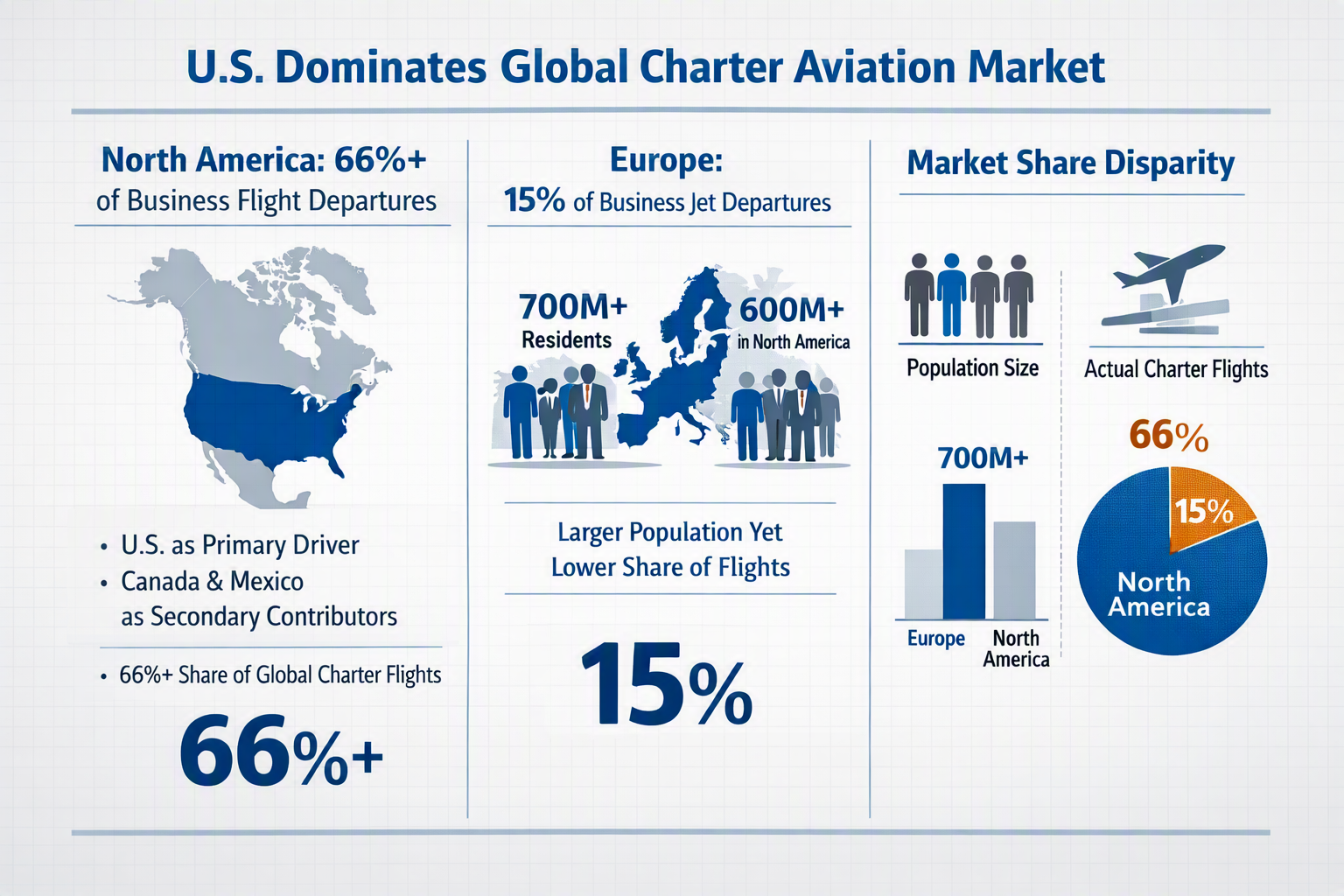
Image generated by AI, reviewed by humans.
As a result, the U.S. regulatory approach to aviation is frequently used to distinguish among various types of flight offerings. The various numbered sections, or “parts,” of the Title 14 of the U.S. Code of Federal Regulations covering “Aeronautics and Space” is, effectively, the reference manual for aviation. Part 91 applies to personal and corporate flights – i.e., you own an aircraft and wish to have yourself flown in it. Part 121 regulates scheduled airlines, while Part 135 covers on-demand charter and commuter flights.
Part 380, on the other hand, has historically been less of a discussion topic – though that is changing. This is the section that the U.S. Department of Transportation (DOT) uses to oversee “public charters” -- operators that sell individual flight tickets to the general public by contracting with direct air carriers. In effect, this serves as a hybrid between Part 135 and Part 121.
The concept of Part 380 effectively means that it is possible to combine some of the advantages of charter with some of the benefits of per-seat airline travel to produce additional options for consumers. While not everyone is thrilled about this (more on that in a bit), it represents a growing industry niche.
Semi-Private
Arguably the most widely known “per-seat charter” company is JSX, which bills itself as providing “a more joyful way to fly.” JSX customers buy seats on Embraer 135 or 145 jets traveling popular short-haul routes on a scheduled basis. Like charter customers, they can skip Transportation Security Administration (TSA) lines, arrive shortly before takeoff, depart from smaller business terminals and sit on roomier seats; unlike charter customers, they can expect to pay less than $1,000 per passenger per flight.

Businesswoman traveling on Private Jet. Photo Credit: Vladimir Vladimirov, Getty Images
For those seeking a more luxurious version of JSX, there is Aero, flying primarily from Los Angeles to a handful of high-end destinations such as Aspen, East Hampton, Sun Valley and Los Cabos, and Tradewind, flying to and from sites in the Caribbean and the Cape Cod area. Travelers who seek to transport bigger pets such as large dogs can buy seats on private jets flown by Bark Air or K9 Jets to bypass limitations imposed by regular airlines.
To some extent, all of those providers are essentially scheduled service airlines grafting certain benefits of private jet travel on top, rather than true charter flights. As a Reddit poster phrased it during one discussion, “Pay per seat is much closer to flying commercial, just without the airport terminal experience…. If you're simply trying to lessen the airport chaos, and there is an operator that has your airports available, then per seat can be a good option.”
However, the growth of business aviation post COVID-19 and the introduction of new technologies have pushed forward innovations that move closer toward something like true per-seat charter.
For example, Aero also offers AeroShare, for clients wishing to pre-finance a charter flight to a corporate or cultural event and then sell individual seats to attendees. Blade Urban Air Mobility, better known for flying clients in helicopters and seaplanes in the Northeast, now provides “crowdsourcing” for charter flights as well. Clients can book a charter flight, and then allow Blade to sell empty seats via its app, to be applied in the form of credits used toward future Blade flights. SharedCharter.com, as its name implies, allows those interested to search a database for others hoping to share charter flights to lower costs.
And then, there’s “private jet marketplace” XO. Become an XO Member via a (refundable) deposit of $100,000 and yearly membership fee of $995 and you get many perks in return -- dynamic pricing based on itinerary, loyalty credit earned per flight, better cancellation terms and, oh yes, eligibility to sell seats on a shared charter.
“XO has assembled a team and developed an approach deeply committed to transforming private aviation and air mobility,” Lynn Fischer, Chief Marketing Officer at XO, said in one announcement about the company’s network. “XO is not merely adapting to the future of private aviation; it's shaping it.”
The Rules Still Apply
That having been said, all of these new developments have not come without opposition. The various “parts” applied to the U.S. aviation industry isn’t just verbiage – it carries weight of differing expectations for differing types of flights.
Pilots for Part 135 flights have to carry a Commercial Pilot Certificate or Airline Transport Pilot (ATP) certificate and require a varying number of flight hours depending on which experience category they fall into. For Part 121 flights, however, all captains and first officers must hold ATP certificates with a minimum of 1,500 hours of experience, and a retirement age of 65 is mandatory. On the passenger side, those flying Part 135 trips must show ID and go through some security procedures, but those traveling via Part 121 get the full delightful TSA experience scanning both baggage and people to ensure safety.
There are quite a few other variations related to matters such as maintenance, pilot training and operational control, but typically, Part 135 operators have more leeway and flexibility than Part 121 entities. The hybrid nature of “public charters,” however – Part 380 – effectively offers the possibility of the convenience of Part 135 with the scheduled service reliability of Part 121…or, from another perspective, the expectations of safety common to airline travel, but with the somewhat less rigid safety and regulatory framework of charter aviation.
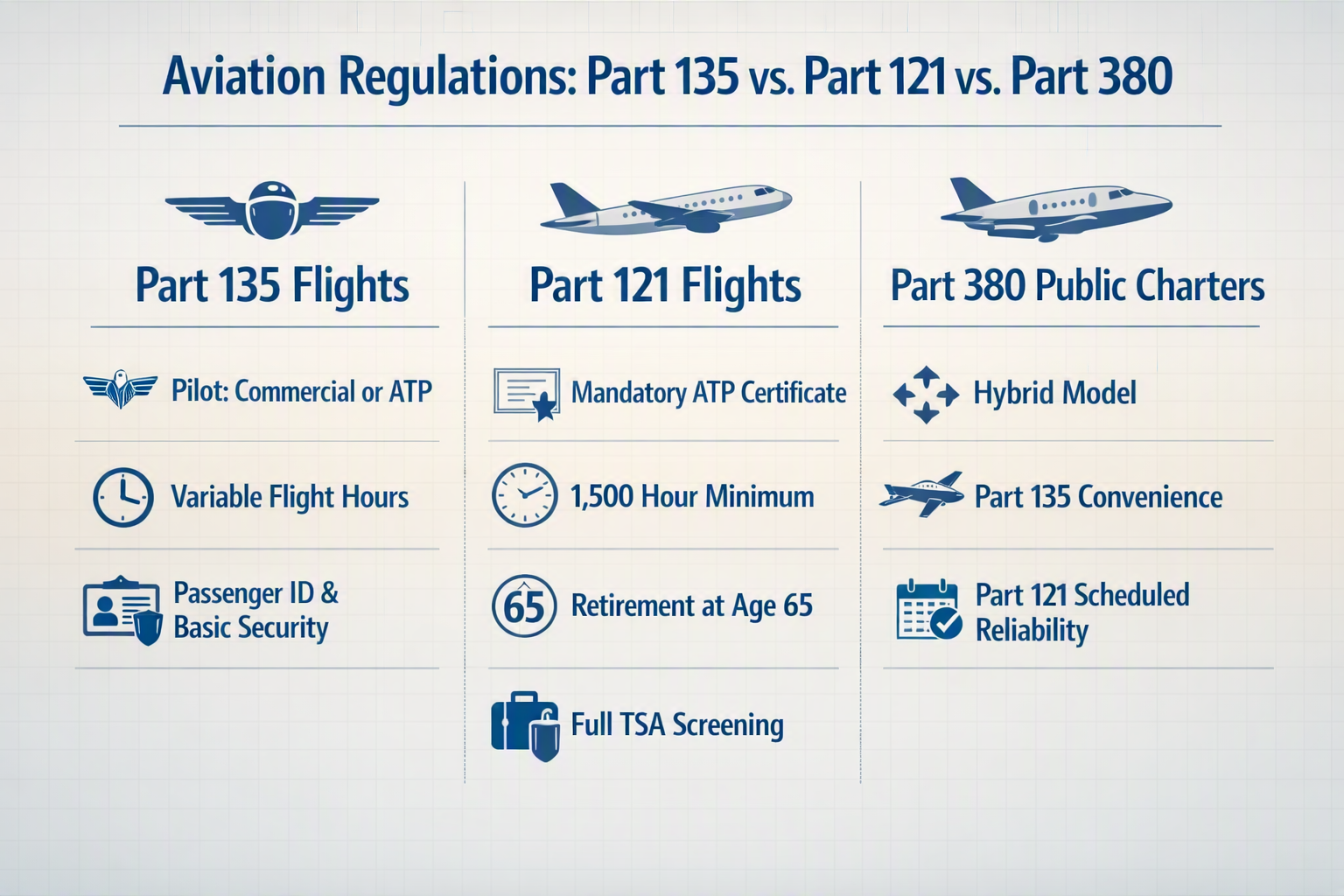
Image generated by AI, reviewed by humans.
In 2023, the U.S. Federal Aviation Administration posted a proposed rule focused on “removing the exceptions for part 380 public charter operators.” Though the FAA did not end up moving forward with those formal efforts, the TSA did indicate at the beginning of 2025 that “semi-private” operators such as JSX and Aero would have to start requiring more in-depth safety screening of passengers using TSA equipment.
How all of this might affect the future of crowdsourced and/or membership-based per-seat charter is unclear – for now, “public charters” are much more high-profile. But the pushback on the expansion of Part 135 flexibility outside of the traditional charter space should be kept in mind as companies and clients consider future developments in per-seat charter.
“Entrepreneurs who witness success in other industries are eager to apply crowdsourcing, sharing economy and other technological solutions to the on-demand charter industry,” says the National Business Aviation Association (NBAA) in its “Guide to Selling Charter by the Seat.” However, “until such time as the DOT and FAA provide more detailed guidance in this area, heightened caution is essential.”