Amsterdam Light Festival: Fifteen Winters on the Canals
/By late November, Amsterdam gives up on daylight by half past four, and the city doesn't seem to mind. The windows along the Herengracht and the Keizersgracht come on one by one, the canal water turns the color of ink, and the bridges start to look less like infrastructure and more like punctuation. This is the setting for the Amsterdam Light Festival, which for fifteen winters has turned the seventeenth-century canal ring, a UNESCO World Heritage Site since 2010, into an open-air gallery of light art that is best seen after dark and, ideally, from the water.
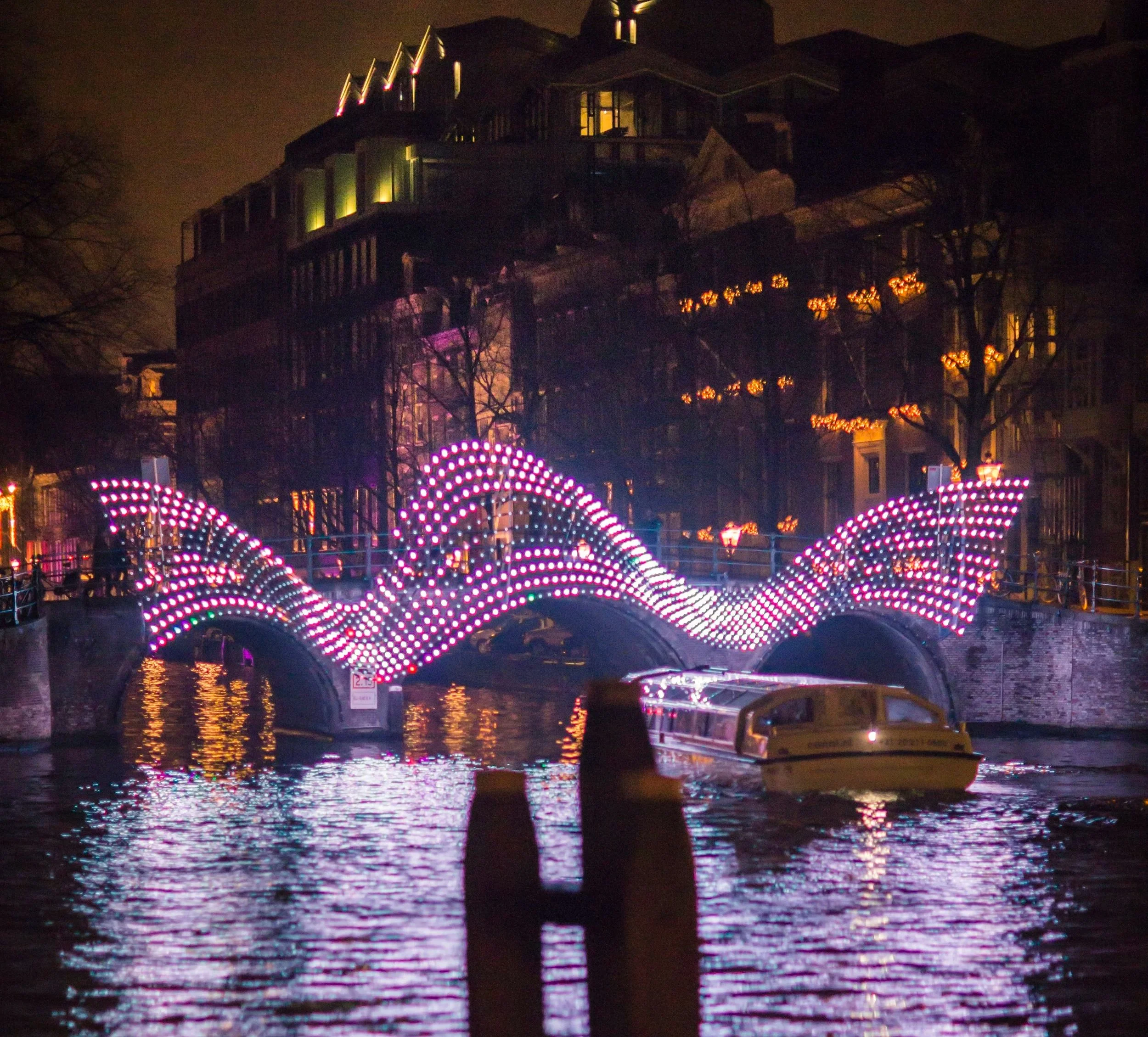
Wave-shaped Light Installation on Amstel river during the Amsterdam Light Festival. Photo Credit: Merten Snijders, The Image Bank / Getty Images
The ring itself dates to the Dutch Golden Age: the city expanded in stages between 1585 and 1665, reclamation for the three great canals began in 1613, and the Herengracht, Keizersgracht, and Prinsengracht still trace the concentric arcs the planners laid out. The festival grew out of a Christmas Canal Parade held in 2009 and, the following year, from Winter Magic Amsterdam, when Rogier van der Heide's lighting of the Skinny Bridge pointed the organizers toward light art. The first edition opened in 2012 as a seven-week boat-viewed light-art route. The idea was not entirely new to the city. In October 1929, Amsterdam staged an Edison Light Week to celebrate the electric light bulb. The difference now is scale and ambition.
Fifteen Years of Light
The fifteenth edition of the Amsterdam Light Festival runs from November 26, 2026 to January 17, 2027, and the organizers have marked the anniversary with a brand new route through the city. Roughly twenty works by local and international artists will be installed along the canals, with free events and side programming planned along the way. The full artist list has not yet been announced. The festival has a habit of attracting serious names. Janet Echelman's suspended net sculpture "1.26 Amsterdam" was the first edition's favorite, a Buckminster Fuller "Fly's Eye Dome" arrived for the second, and Ai Weiwei contributed "Thinline" to the sixth. Princess Beatrix opened the fourth edition, and by the fifth, close to a million people were coming to see the work. The festival has bent without breaking: during the pandemic winter of 2020 to 2021, it shrank to seven artworks scattered across the city, and the 2024 to 2025 edition celebrated Amsterdam's 750th anniversary. Last winter's edition, built around the theme "Legacy," also saw a leadership change, with Dago Houben and Pam Toonen taking over as managing director and artistic director. A non-profit cultural foundation runs the whole enterprise.
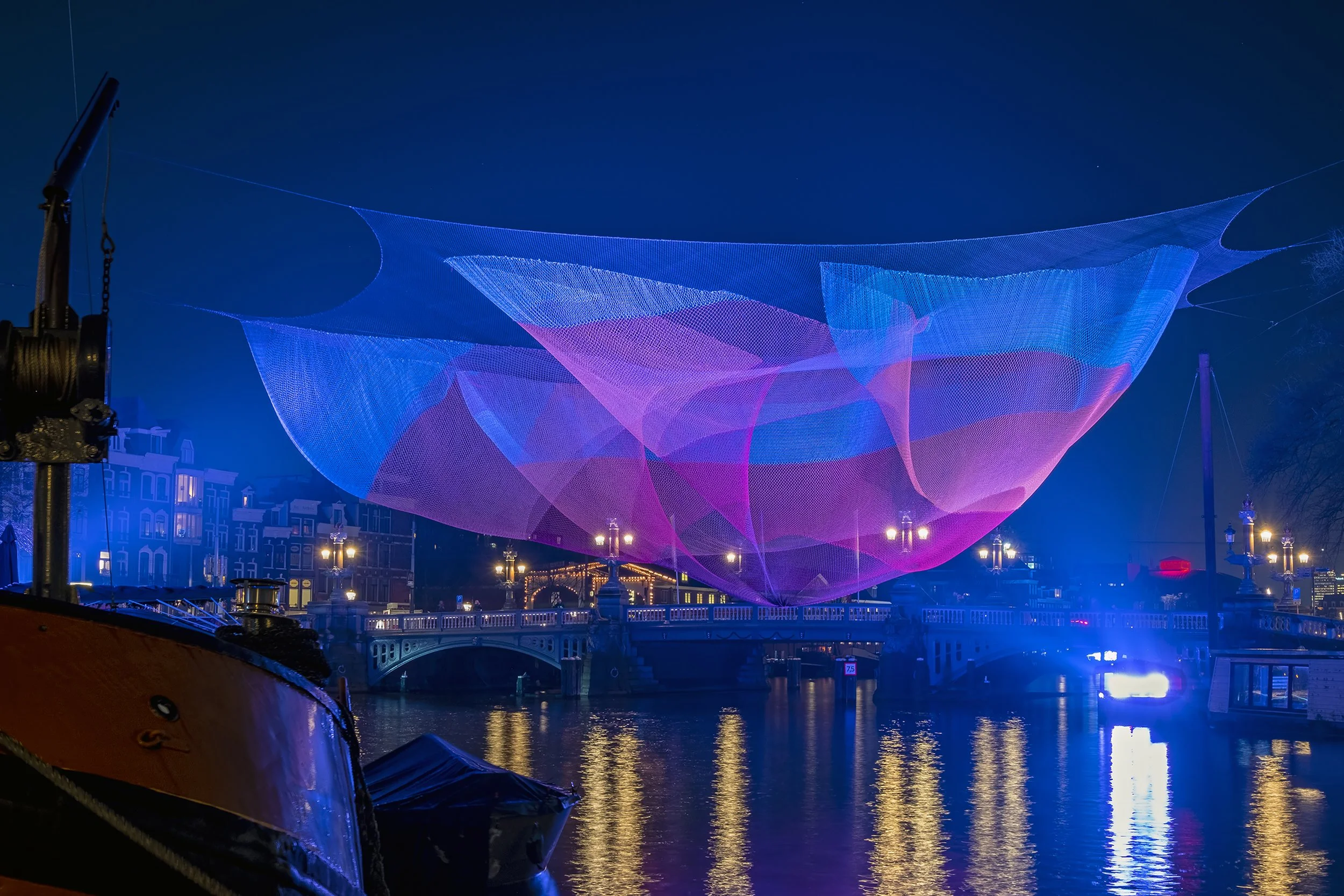
Janet Echelman's suspended net sculpture "1.26 Amsterdam" from the firsT Amsterdam Light Festival. Photo Credit: GM, Istock / Getty Images Plus
You can experience the route on foot or by boat, and your choice shapes the evening. Walking lets you move at a slower pace, with time to stop on a bridge and watch an installation reflect in the water below. The boat, with its audio tour and low angle, offers the view the festival was built around: each artwork appears out of the dark at water level, then slides past. Boat and walking tickets start at €29.75; the festival app guides visitors through the theme, and information points along the route hand out a limited number of printed maps. The lights switch on in the early evening and stay on until 10 or 11 p.m. depending on the day of the week, with extended hours every night from December 19 to January 3.
Those holiday weeks are the festival's peak, when the route stays lit latest, and the city is most crowded and festive. New Year's Eve is the one exception: the installations go dark at 9 p.m., and the city's attention turns to midnight.
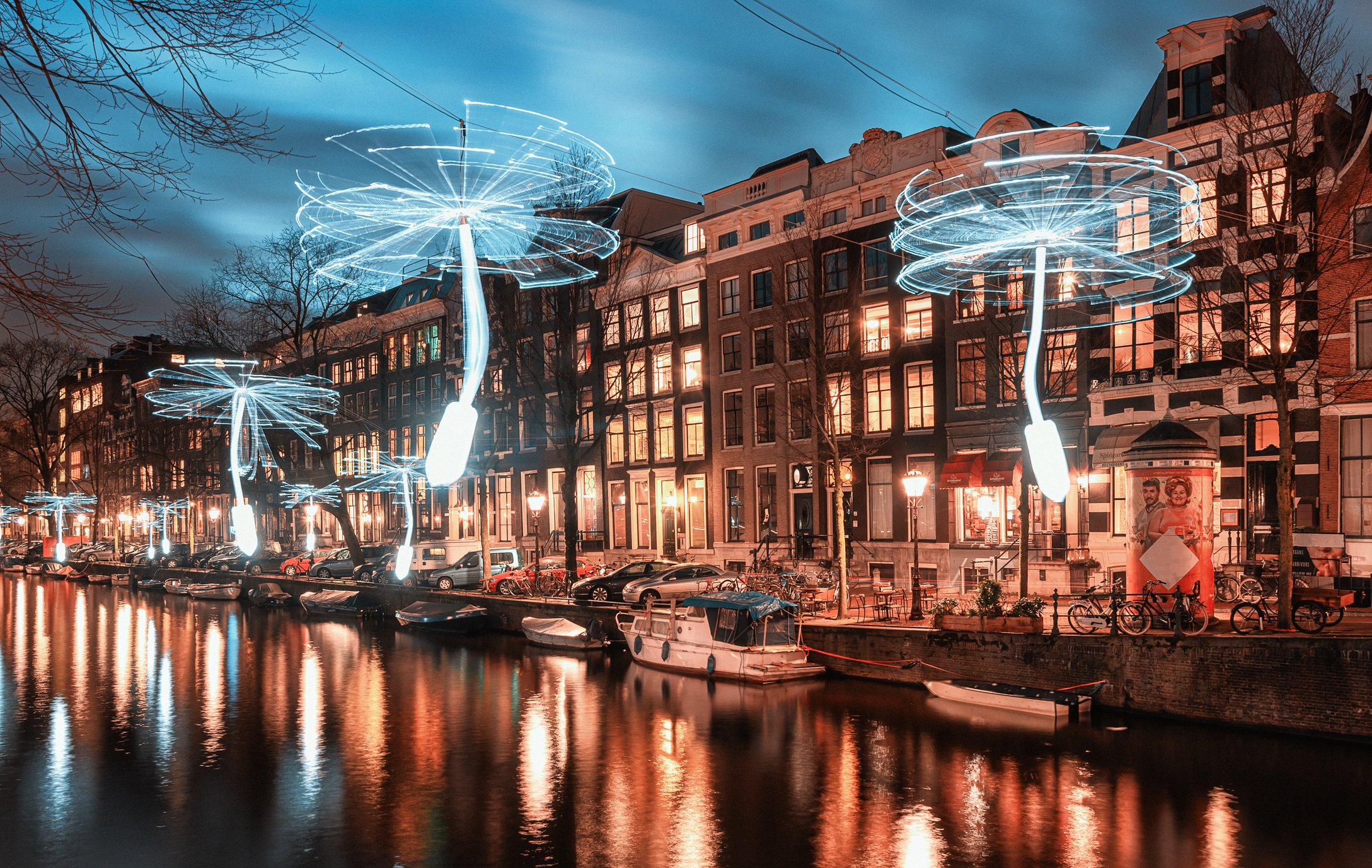
Wind-driven propellers above the HerenGracht during the 2019 Amsterdam Light Festival. Photo Credit: Julia700702, istock / Getty Images Plus.
Where to Stay
Pulitzer Amsterdam occupies twenty-five interlinked canal houses from the seventeenth and eighteenth centuries, stretching between the Prinsengracht and the Keizersgracht, which makes it less a hotel than a small neighborhood with room service. It began in 1970, when Peter Pulitzer, grandson of newspaper publisher Joseph Pulitzer, bought twelve houses on the two canals and set about joining them. Over roughly three decades, the hotel grew to its present size, and its largest restoration in 2015 and 2016 was shaped by Jacu Strauss, creative director of Lore Group, who drew on canal-house details, a painting in the Rijksmuseum, and a boat trip through the canals. The 225 rooms are spread across the houses and around the hotel's gardens. The Book Collector's Suite features an archway of books running floor to ceiling, Pulitzer's Bar keeps an Art Deco room for the hours after a canal tour, and the hotel also keeps the Tourist, a restored salon boat built in 1909. The hotel describes itself as Amsterdam's oldest five-star hotel, a claim it has had more than fifty years to earn.
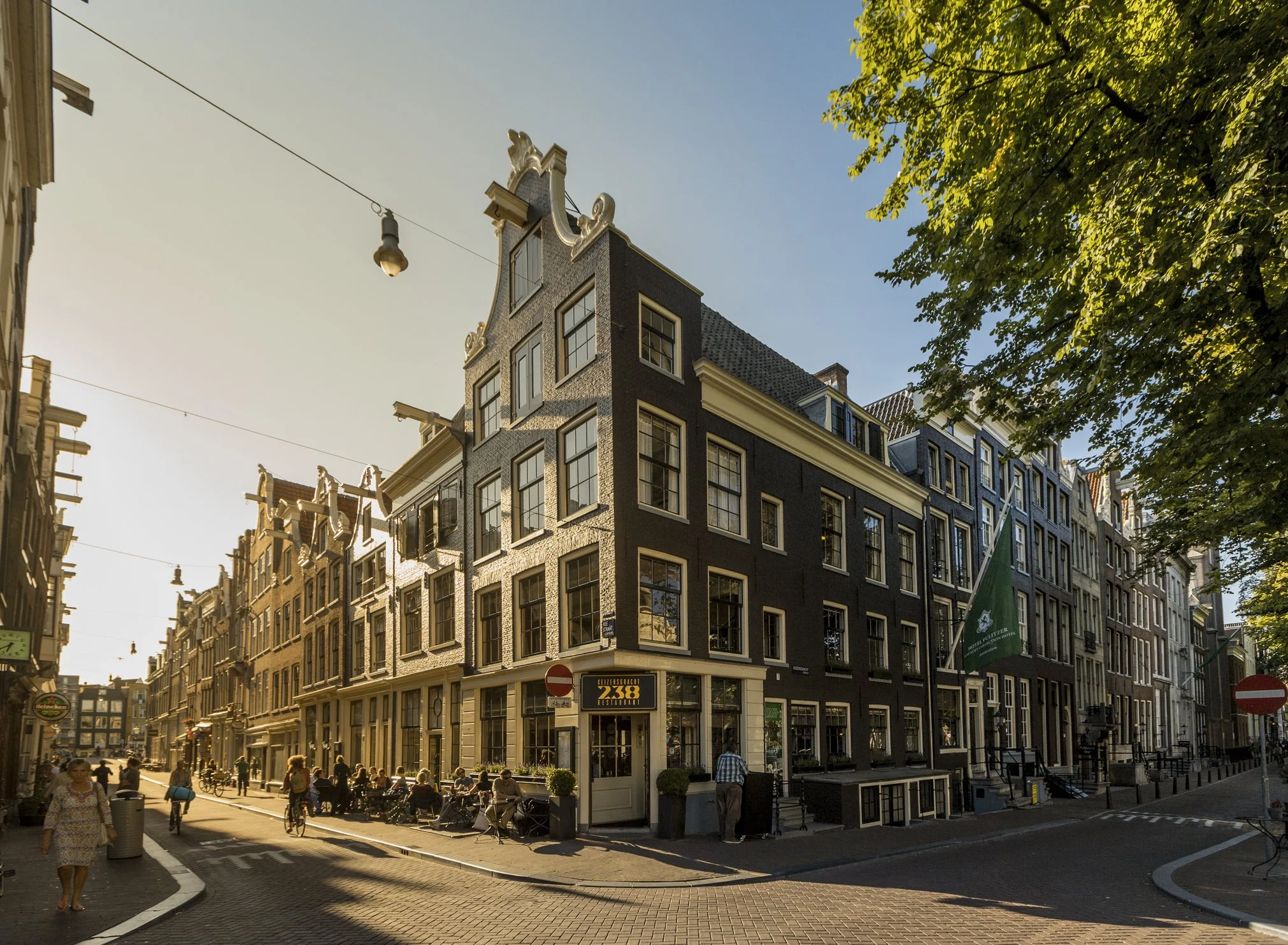
The Pulitzer hotel along the Keizersgracht canal in Amsterdam. Photo Credit: Merten Snijders, The Image Bank / Getty Images
For a different kind of Amsterdam history, De L'Europe stands on the Amstel opposite the Munt tower, on ground occupied since 1482, when the city built a defensive tower called Het Rondeel on the site. An inn followed in 1638, partly on the fort's foundations, and in 1845 Het Rondeel reopened as Amsterdam's first family-focused hotel. Auctioned off in 1894, it sat empty for two years and was slated for demolition. The present hotel, designed by architect Willem Hamer Jr., opened on September 23, 1896, with fifty rooms. In the twentieth century, Freddy Heineken made it a favorite, frequenting it from the 1950s and eventually buying it; the bar still carries his name. Dutch design studio Nicemakers fully redesigned the hotel in 2020, and today it has 107 rooms and 55 suites on the river. It is a member of the Leading Hotels of the World.
Where to Eat
Ciel Bleu, on the 23rd floor of Hotel Okura, earned its first Michelin star in 2005, added a second in 2008, and retained both in the 2026 guide. From that height, the city reads as a field of light, which suits a festival week. Chef Arjan Speelman builds the menu on French technique, layered with Asian seasonings and the kind of deep, carefully reduced sauces that have become the kitchen's calling card. The signature dish is marinated bluefin tuna tartare with yuzu, horseradish cream, egg yolk, and caviar. Maître d' Francesco Simonelli runs a dining room Michelin inspectors single out as one of the best in the country, with windows framing the Amsterdam skyline in every direction.
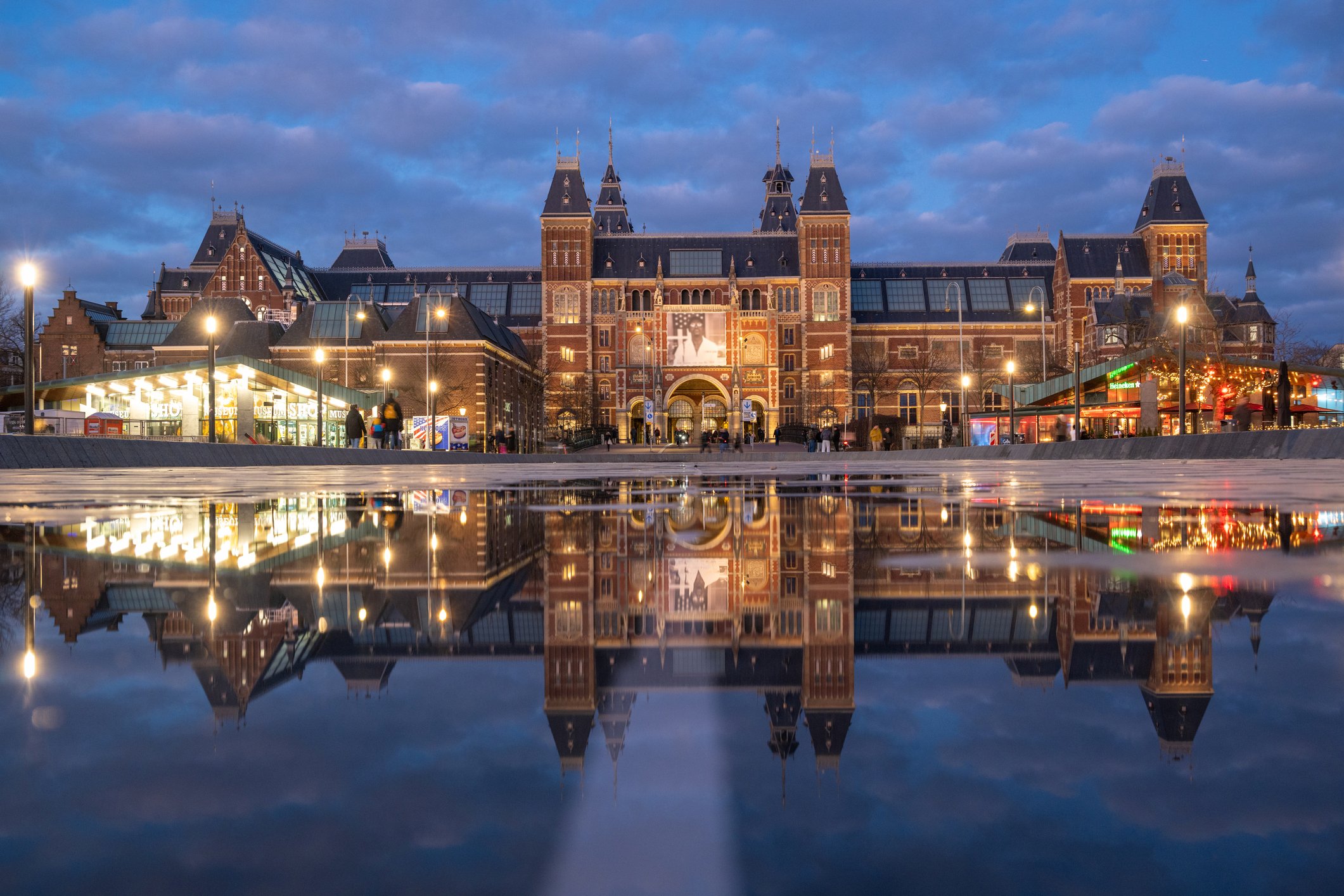
Rijksmuseum in Amsterdam. PHoto Credit: Pachantouris, Getty Images
RIJKS, set within the Rijksmuseum, takes the opposite approach and looks inward, toward the Netherlands itself. Executive Chef Joris Bijdendijk, who now leads the kitchen alongside chefs Friso van Amerongen and Victor Melendez Barranco, opened the restaurant in 2014, focusing on the cuisine of the Low Countries, built on the simplicity and quality of Dutch produce, local sourcing, and the international influences that run through Dutch cooking. The kitchen earned its first Michelin star in 2016 and holds it in the 2026 guide, and a 2023 renovation gave the dining room a completely new interior. Dinner here works naturally after an afternoon in the galleries, when the museum's own collection has already set the tone.
Beyond the Canals
The Rijksmuseum deserves the afternoon. Pierre Cuypers designed the building, which went up from 1876, opened in 1885, and reopened in 2013 after a ten-year renovation that cost €375 million. The Gallery of Honor on the second floor holds the collection's Golden Age masterpieces, with Vermeer nearby and Rembrandt's "The Night Watch" drawing crowds as always.
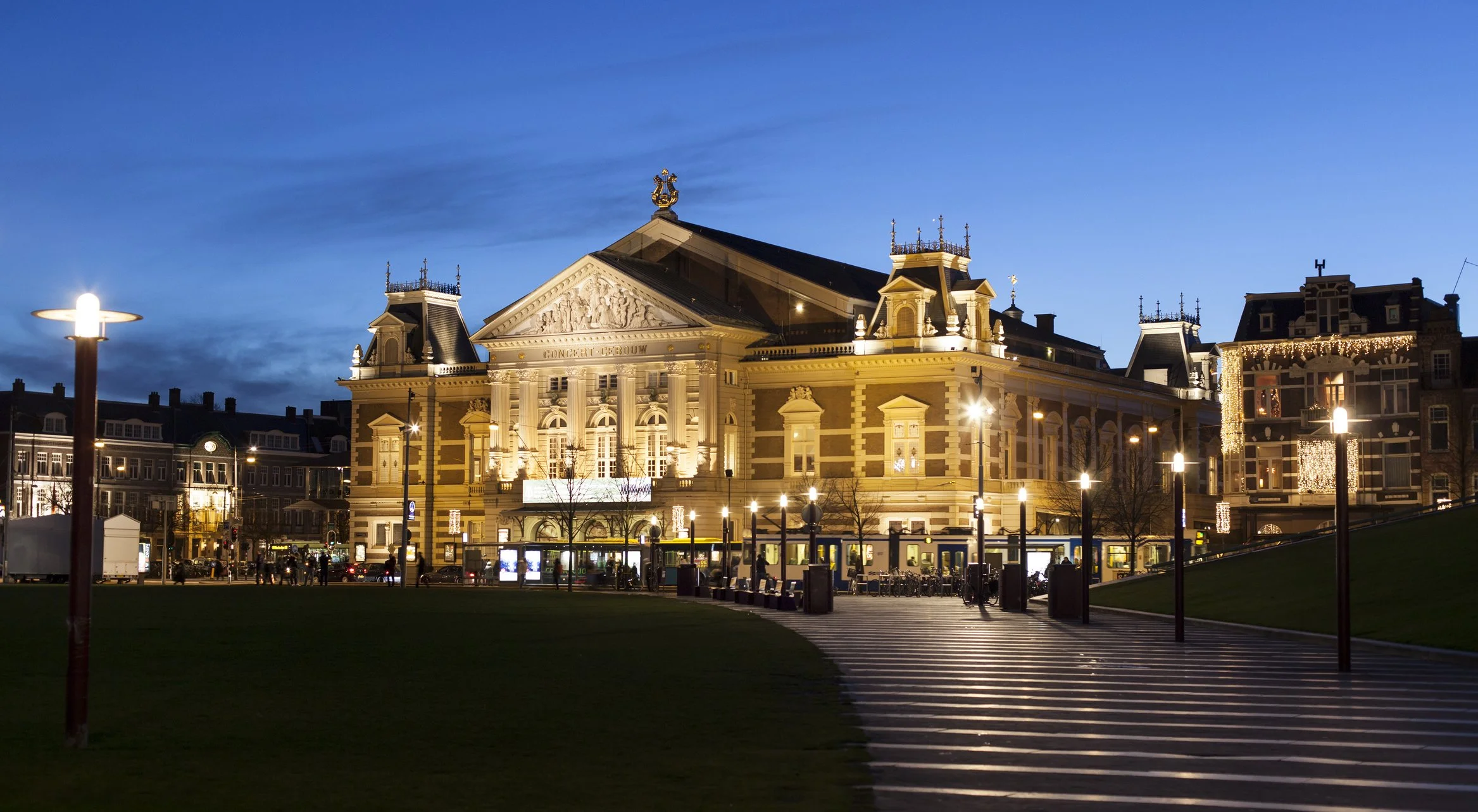
Royal Concertgebouw Amsterdam seen from Museumplein. Photo Credit: Ollo, iStock / Getty Images
A short walk across Museumplein, the Royal Concertgebouw has hosted music since it opened in 1888. It is acclaimed for its acoustics and is home to the Royal Concertgebouw Orchestra. More than 800,000 people attend each year, and an evening concert in the Main Hall, followed by a slow walk back along the canals past the installations, is the kind of night only this city, in this season, can arrange.
The Case for a Winter Visit
What the Amsterdam Light Festival offers, in the end, is a reason to see a famous city at the hour most day visitors have already left. Fifteen years of light art on canals dug four centuries ago. A hotel made of twenty-five canal houses, and another on the site of a fifteenth-century tower, where you can dine on the 23rd floor above the lights, just steps from Rembrandt. Very few cities improve after dark, and almost none improve this much.
To make your journey as seamless as the adventure itself, trust Air Charter Guide for comprehensive, up-to-date flight booking information, so every step of your trip is smooth and stress-free. The lights stay on until January 17, and the canals will look exactly as they should from the moment you land, so let Air Charter Guide help you get there.